Hip-hop mogul and entrepreneur Rick Ross has dramatically escalated his long-standing fascination with exotic animals by acquiring a lion, declaring himself the modern incarnation of boxing legend Mike Tyson. The stunning revelation came via a video posted by DJ Y, where Ross introduced the lion, named Simba, to his followers. This move immediately draws direct parallels to Tyson’s own history of keeping big cats, cementing Ross’s “biggest boss” persona in a uniquely visceral way.
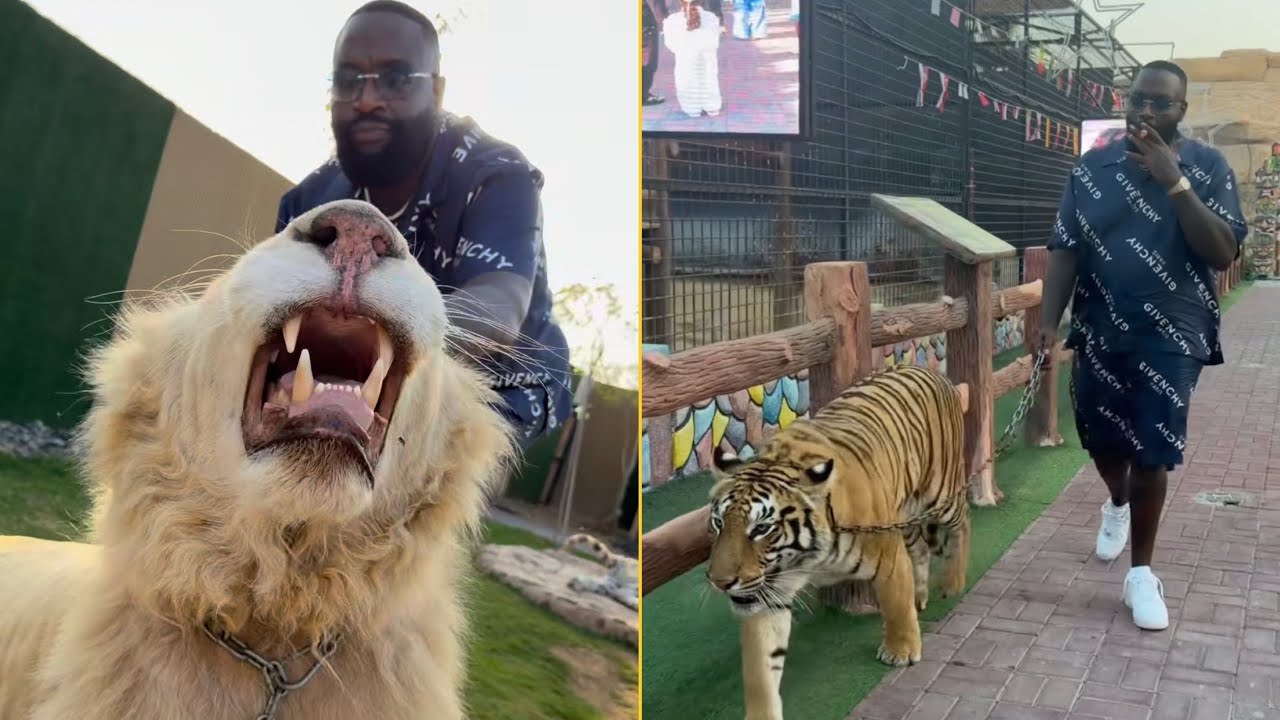 In the clip, Ross is seen confidently handling the majestic animal, stating emphatically, “I’m introducing y’all to Simba.” His demeanor underscores a belief that such a powerful creature is a natural extension of his personal brand. The rapper and business magnate then directly addresses his critics and the surreal nature of the moment, asserting, “This ain’t no AI,” ensuring viewers of the authenticity of his dangerous new companion.
The video quickly pivots to fan commentary, highlighting that social media observers have been comparing Ross’s trajectory to that of “Iron Mike” Tyson. Ross appears to embrace this comparison fully, nodding to the legacy of the former heavyweight champion who was famously known for owning tigers during the peak of his career. This association is not merely about pet ownership but symbolizes a shared aura of untamable power and formidable presence.
Ross’s declaration as a “modern Mike Tyson” transcends simple animal acquisition. It represents a calculated evolution of his carefully curated empire of luxury, strength, and intimidation. Where Tyson dominated the ring, Ross dominates the boardroom and the studio, and now, symbolically, the animal kingdom. The lion serves as a living metaphor for his position in the hip-hop hierarchy.
The footage concludes with a powerful visual statement: Ross walking the lion on a leash. A voiceover declares, “The pictures ain’t enough. The boss got to walk the lion,” emphasizing that for Ross, image is everything, but tangible, lived experience is paramount. This act is the ultimate display of control and fearlessness, designed to solidify his legendary status.
Animal rights organizations are likely to scrutinize this development heavily. Mike Tyson’s own history with exotic pets was fraught with controversy, including a well-publicized incident where his tiger attacked a woman. Ross’s foray into similar territory invites immediate questions about licensing, safety protocols, and the welfare of the animal itself in a domestic setting.

Legal experts note that ownership of big cats like lions is heavily regulated and varies drastically by state and locality. Permits often require extensive safety measures, secure habitats, and proof of expertise. Whether Ross has secured all necessary documentation and maintains a USDA-approved facility will be a subject of intense public and legal interest in the coming days.
The cultural impact is instantaneous, flooding social media platforms with reactions ranging from awe to severe criticism. Fans of the “Maybach Music” boss celebrate the move as the ultimate power flex, while detractors condemn it as irresponsible and a potential danger to his community. The Tyson comparison has become the central frame for the online discourse.
This event is not an isolated incident in Ross’s narrative. His sprawling Georgia estate, the Promise Land, has long been home to buffalo and other animals, reflecting his desire to cultivate a larger-than-life, almost monarchical lifestyle. The addition of a lion, however, marks a significant and provocative escalation in that ongoing project.
Industry analysts suggest this is a masterstroke in personal branding, cutting through the digital noise with a stark, unforgettable image. In an era of virtual influencers and AI-generated content, Ross’s tangible, dangerous reality commands a different kind of attention. It reinforces his authenticity in a landscape he often criticizes as soft or artificial.

The comparison to Mike Tyson is particularly resonant given Tyson’s recent reinvention as a pop culture icon and entrepreneur. By aligning himself with Tyson’s legacy of ferocity, Ross taps into a timeless archetype of the feared and respected champion. It’s a symbiotic reference that elevates both men’s mythologies.
Neighbor and community safety concerns are now at the forefront. Local authorities in Fayette County, Georgia, where Ross’s estate is located, will undoubtedly face pressure to investigate the legality and safety of housing a large predator. The potential for escape, however remote, poses serious questions for residents in the vicinity.
Veterinarians specializing in exotic animals warn that lions, even when raised in captivity, remain wild predators with instincts that can be triggered unexpectedly. The complex needs for space, diet, and enrichment are immense and costly, far beyond the means of most private owners, raising ethical debates about private ownership of such species.
Ross’s move coincides with the recent passage of the federal Big Cat Public Safety Act, which restricts private ownership and public contact with big cats. The law’s specific provisions and grandfather clauses will be tested by cases like this, potentially placing Ross at the center of a national legal debate on exotic animal laws.

The business ramifications are equally significant. Rick Ross has built an empire on the perception of unrivaled success and boldness. This act, while controversial, feeds directly into that narrative, potentially boosting engagement across his music, wingstop franchises, and other ventures through sheer notoriety and conversation.
As the story develops, the world will be watching for official statements from Rick Ross’s camp regarding the animal’s origin, care, and legal standing. Environmental and animal welfare agencies may already be mobilizing to conduct assessments. The spectacle of “Rozey” with his lion is only the beginning of a much larger, complex story.
The legacy of Mike Tyson’s tigers looms large over this situation, serving as both a blueprint and a cautionary tale. Ross seems intent on capturing the former while navigating the latter. His ability to manage the immense responsibility and public scrutiny will define this chapter of his career as much as any album release.
For now, the image of Rick Ross walking Simba the lion is seared into the public consciousness. It is a raw display of power, a provocative statement of identity, and a challenge to conventional norms. Whether viewed as the ultimate boss move or a profound misstep, it undeniably confirms that Rick Ross continues to operate on a scale few can comprehend or emulate.